| CAM | 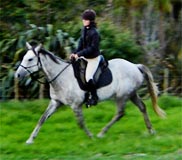 |
| BREED | : | TB |
| AGE | : | 5 years old |
| HEIGHT | : | 16 hh |
|
COMMENTS
Cam lost shoes frequently and had tender hooves. Although he was diagnosed with a box hoof and his hooves were very unsymmetrical, this is simply due to incorrect trimming, and over time will resolve itself completely. The after photos do not show a perfect hoof, however the hooves are well on their way to becoming strong, healthy and well functioning. |
 |
|
 |
 |
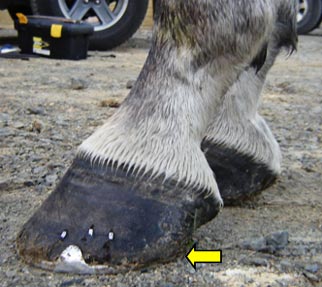
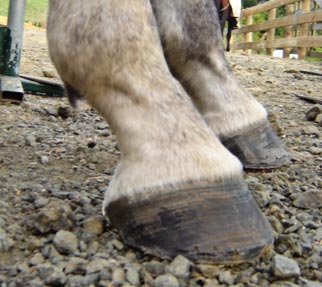
Before 1st Corrective Trim
Left Front - Side View
04.04.09 |
|
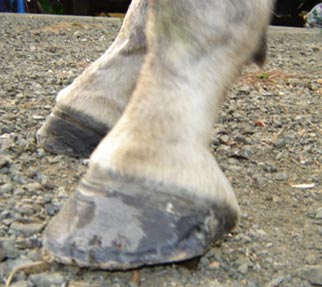
After 1st Corrective Trim
Left Front - Side View
04.04.09 |
|
 |
|
 |
|
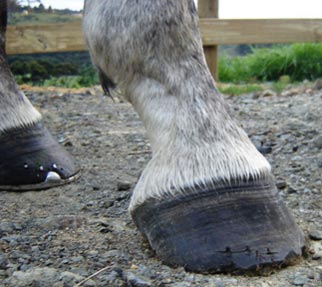
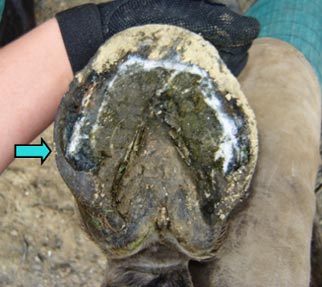
Before 1st Corrective Trim
Right Front - Side View
04.04.09 |
|
After 1st Corrective Trim
Right Front - Side View
04.04.09 |
|
 |
|
 |
|
Before 1st Corrective Trim
Right Hind - Underneath View
04.04.09 |
|
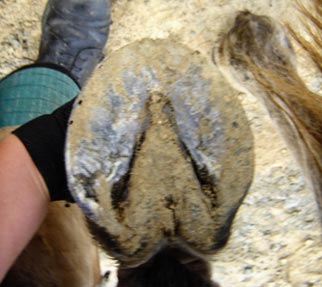
After 1st Corrective Trim
Right Hind - Underneath View
04.04.09 |
|
Under run heels - observation
The tendency for forward (rather than upward) hoof growth, along with incorrect or infrequent trimming has resulted in heels that have migrated too far forward, with downward force being concentrated in an area which has no support. (yellow arrow)
Action taken
By applying correct trimming techniques, heel support has been created as much as possible, and over time more upright growth will be encouraged.
|
Flat soles - observation
The soles are flat due to shoeing, incorrect weight distribution or lack of exercise.
Action taken
By correcting the distribution of weight along with increased movement, the hoof will function as a flexible structure, and the sole will naturally become more concave.
|
Dead tissue on soles - observation
From lack of ground contact and/or movement, dead sole tissue has failed to exfoliate.
Action taken
After removal of built up dead tissue, the sole has transformed into a functional more concave structure.
|
Black thrush - observation
Little or no contact of the sole with the ground has prevented it from exfoliating naturally. This has caused a build up of dead tissue which has been invaded by bacteria/fungi, giving the affected area a blackish appearance on the surface. When partially removed, a crumbly white interior is revealed. (turquoise arrow)
Action taken
With the cause of the problem removed along with all dead tissue - stimulation by ground contact will prevent this from reoccurring.
|
Thin hoof walls - observation
Thin hoof walls can originate from a number of causes, and are often an indication that the hoof is not functioning as nature has designed. Often genetic tendencies are blamed for thin hoof walls, but it is more often the practice of shoeing, incorrect trimming or lack of exercise which has created hoof dysfunction, and therefore can be corrected very easily over time with owner commitment.
Action taken
With frequent correct barefoot trimming, along with plenty of exercise on hard, flat surfaces, hoof walls will become thick and healthy.
|
| Back to Hoof Trimming Gallery |