| CODY | 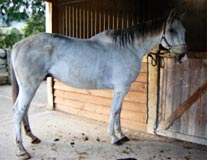 |
| BREED | : | TB |
| AGE | : | Unknown |
| HEIGHT | : | 16.2 hh |
|
COMMENTS
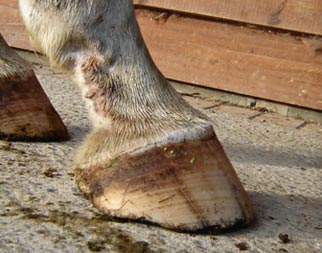
Cody has been previously trimmed by another barefoot hoof trimmer, however the application has been incorrect. There has been no work completed on the sole, there is longstanding and unresolved splits and flares (which the owner was advised would not be able to be resolved), and there has been no mustang roll applied at all. The after photos do not show a perfect hoof, however the hooves are well on their way to becoming strong, healthy and well functioning. |
 |
|
 |
 |
Before 1st Corrective Trim
Right Hind - Side View
28.03.09 |
|
After 1st Corrective Trim
Right Hind - Side View
28.03.09 |
|
 |
|
 |
|
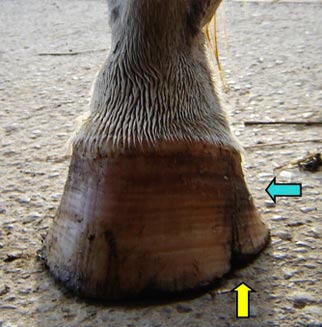
Before 1st Corrective Trim
Left Hind - Front View
28.03.09 |
|
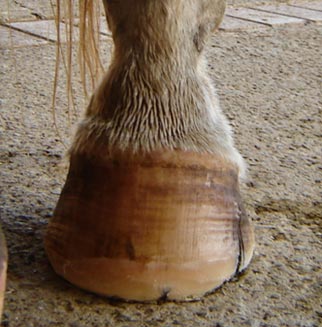
After 1st Corrective Trim
Left Hind - Front View
28.03.09 |
|
Splits and chips - observation
The splits, chips, cracks and breakages have occurred due to a combination of factors - usually poor hoof horn along with either infrequent or incorrect trimming. (yellow arrow)
Action taken
The splits, chips, cracks and breakages have been removed as much as possible. With consistent and correct trimming these will not reoccur.
|
Flares one side - observation
Misalignment of the skeletal structure or incorrect trimming has contributed to excessive strain on one side of the hoof. Because of this uneven weight distribution, one side has grown long and flared which indicates there is probable stretching of the laminar/wall connection. (turquoise arrow)
Action taken
The alignment is now corrected and supported as much as possible. With each consecutive and consistent trim the flaring will be resolved.
|
Flat soles - observation
The soles are flat due to shoeing, incorrect weight distribution or lack of exercise.
Action taken
By correcting the distribution of weight along with increased movement, the hoof will function as a flexible structure, and the sole will naturally become more concave.
|
Thin hoof walls - observation
Thin hoof walls can originate from a number of causes, and are often an indication that the hoof is not functioning as nature has designed. Often genetic tendencies are blamed for thin hoof walls, but it is more often the practice of shoeing, incorrect trimming or lack of exercise which has created hoof dysfunction, and therefore can be corrected very easily over time with owner commitment.
Action taken
With frequent correct barefoot trimming, along with plenty of exercise on hard, flat surfaces, hoof walls will become thick and healthy.
|
| Back to Hoof Trimming Gallery |