| HAPPY | 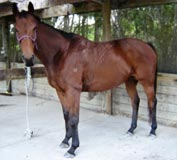 |
| BREED | : | TB |
| AGE | : | 8 years old |
| HEIGHT | : | 16 hh |
|
COMMENTS
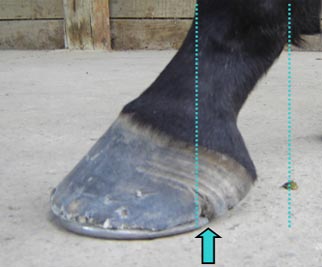
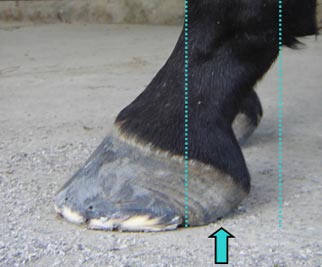
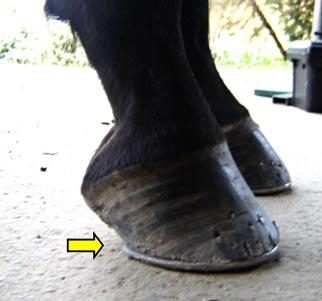
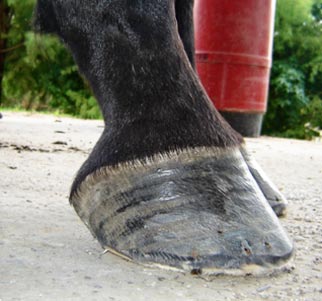
Happy's hooves have been trimmed by a farrier in the past and are terribly unsymmetrical. The left front has developed a stress related quarter crack (from unsupported downward force and under run heel) and the right front has extremely high heels. After just one trim, the difference in correct weight distribution and also progress towards symmetry is amazing. The after photos do not show a perfect hoof, however the hooves are well on their way to becoming strong, healthy and well functioning. |
 |
|
 |
 |
Before 1st Corrective Trim
Left Front - Side View
13.04.09 |
|
After 1st Corrective Trim
Left Front - Side View
13.04.09 |
|
 |
|
 |
|
Before 1st Corrective Trim
Right Front - Side View
13.04.09 |
|
After 1st Corrective Trim
Right Front - Side View
13.04.09 |
|
High heels - observation
The heels are too high, which promotes a toe first landing. This inhibits extension of joints in the limb, places stress on the tendons and ligaments, and incorrectly distributes weight onto the front area of the hoof - an area not designed to incur such extreme force. (yellow arrow)
Action taken
By lowering the heel height as much as possible, the weight is more correctly distributed which promotes a heel strike. This results in the correct utilisation of shock absorption structures, expansion of the hoof and also extension of the limb.
|
Under run heels - observation
The tendency for forward (rather than upward) hoof growth, along with incorrect or infrequent trimming has resulted in heels that have migrated too far forward, with downward force being concentrated in an area which has no support. (turquoise arrow & turquoise dotted lines)
Action taken
By applying correct trimming techniques, heel support has been created as much as possible, and over time more upright growth will be encouraged.
|
Splits and chips - observation
The splits, chips, cracks and breakages have occurred due to a combination of factors - usually poor hoof horn along with either infrequent or incorrect trimming. (also turquoise arrow)
Action taken
The splits, chips, cracks and breakages have been removed as much as possible. With consistent and correct trimming these will not reoccur.
|
Flat soles - observation
The soles are flat due to shoeing, incorrect weight distribution or lack of exercise.
Action taken
By correcting the distribution of weight along with increased movement, the hoof will function as a flexible structure, and the sole will naturally become more concave.
|
Thin hoof walls - observation
Thin hoof walls can originate from a number of causes, and are often an indication that the hoof is not functioning as nature has designed. Often genetic tendencies are blamed for thin hoof walls, but it is more often the practice of shoeing, incorrect trimming or lack of exercise which has created hoof dysfunction, and therefore can be corrected very easily over time with owner commitment.
Action taken
With frequent correct barefoot trimming, along with plenty of exercise on hard, flat surfaces, hoof walls will become thick and healthy.
|
| Back to Hoof Trimming Gallery |